Articles
Gas protection for Women and Beardy employees
Current article focuses on the provision of the filter hoods, which are in use for our Sour facilities and the Emergency Planning Zones, to protect personnel in the event of an accidental release.Filt

Current article focuses on the provision of the filter hoods, which are in use for our Sour facilities and the Emergency Planning Zones, to protect personnel in the event of an accidental release.
Filter hoods are used where it can be demonstrated that their use is more appropriate than the typical supplied air RPE, which is heavy, cumbersome and typically has a limited working duration.
However, it is known that facial hair (beard) can reduce the effectiveness of the filter hoods, as the seal between the face and the product is impaired. Despite there being many products on the market none of them had been demonstrated for use with facial hair. PDO was keen to fully understand the effect of both facial hair and long hair, in order to protect our personnel effectively. This note provides details of the filter hood trials which were conducted in 2017.
Planning for Trials
PDO Corporate HSE Department conducted trials to determine what protection level is offered by filter hoods, when the wearer has facial or long hair.
These trials were conducted for 3 filter hoods types:
The existing hood which was in use in PDO – the Sundstrom SR-76,
Avon NH-15 and
one other.
Once the trial results were known a decision was taken by PDO management to change to Avon NH-15
Once the trial results were known a decision was taken by PDO management to change to Avon NH-15 as it provided an enhanced level of protection for persons with facial hair.
The majority of Sour sites or EPZs for Critical Sour sites are now in the process of moving over to the NH-15 Hood.
The existing supplied air escape RPE which is in use at facilities should be utilised as normal.
Note: These trials do not impact the current arrangements for Breathing Apparatus, such as for confined space entry or breaking containment.
PDO engaged a specialist independent testing organisation called Pro-Qares, from The Netherlands, to conduct the filter hood trials.
Trials
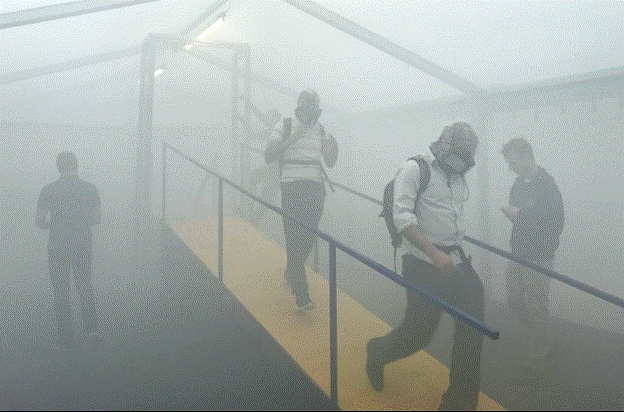
There were 3 weeks of trials, where over 100 volunteers tested three different hoods.
4 different goups were identified:
Clean Shaven,
1 week facial hair growth,
Full beard and
Long Hair.
Each individual had their face measured, to ensure a cross section of facial sizes were considered. Each was trained to don the equipment in line with manufacturer’s rec-ommendations. The volunteers spent 20 minutes with each hood conducting exer-cises such as walking, running, and climbing ladders inside a Marquee which was filled with an aerosol of medicinal grade oil.
The measurements were taken using a ‘portacount’ machine which is in a backpack worn by the test volunteers. It measures the numbers of particles in the nose cup of the mask every second and records it. The external concentration is measured by a separate device on regular intervals.
The results are then averaged per activity, and person within their category. Based on the ratio of particles inside the mask versus outside the mask we get a Protection Fac-tor. This Protection Factor, known as the Simulated Workplace Protection Factor can then be used to identify where PDO can deploy the Filter Hoods and where an sup-plied air RPE is required.
In addition, all the volunteers were asked to provide their feedback and notes were taken during the trials. All the hoods suf-fered from the same issues of condensation and heat build up inside.
Conclusion
So what’s the current arrangement for our facilities?
As a result of the trial, we will use the’ Avon NH-15’ hoods in our Emergency Planning Zones (EPZ), which are areas which surround Critical Sour Facilities, and also in our Sour Facilities.
This is based on its ability to filter out 4400 ppm H2S. In areas where the concentration of H2S in the fluids is very high and a release could cause immediate fatalities, (Red and Yellow Zones) supplied air RPE will continue to be provided.
The ‘Avon NH-15’ hoods are rated via their standards for 40 min duration, and the manufacturer says they can be worn for longer durations, however, given the issue with heat and condensation as evidenced at the trials, it is advisable to remove the hood as soon as it considered safe to do so.
Women using Gas Protection Hoods
We have some specific information from the trials for Women working on site.
Before the emergency:
Ensure you have no hair pins in your hair which can tear the mask.
Ensure that your hairstyle does not limit your ability to don the mask, or impair the seal. A large ‘bun’ can make it very difficult to put the mask on. Long untied hair can also be difficult to clear from the mask seal. A simple ponytail or plait is the preferred hairstyle.
Contact alkahtib@pdo.co.om for more info
Comments
Sign in to join the conversation