Articles
Permit to Work Procedure
RoleSubsystem OwnerResponsibilityThe PTW Subsystem Owner shall be responsible for ensuring:To maintain a high standard of quality and content for all PTW system documentation.To ensure that the system
Role
Subsystem Owner
Responsibility
The PTW Subsystem Owner shall be responsible for ensuring:To maintain a high standard of quality and content for all PTW system documentation.
To ensure that the system in place delivers the necessary documentation to users
To define the tools required for PTW system, including location boards, isolation tools like padlocks and tags
To ensure that briefing is delivered on any changes to the system
To ensure that auditing is being done as per the audit scheme
To ensure that all personnel are trained and competent in the operation of the PTW system appropriate to their role in the system;
Position
HSE Manager
Role
Responsible Supervisor
Responsibility
Person responsible for implementation of the PTW System at the work sitePre-task responsibilities:
Verifies that all hazards have been identified;
Confirms that risk assessment includes the controls needed to prevent harm to personnel, asset and the environment;
Agrees that the work can be done on particular equipment at the proposed time;
Confirms that there is no conflict between activities and will incorporate all necessary controls to prevent interactions prior to approving PTW for activities taking place simultaneously;
Examines the worksite, normally with the Permit Holder, before authorising the PTW, to ensure that all hazards have been identified and controls recorded;
Establishes effective communication between concurrent activities, for shift handovers & within the workgroup itself;
Approves and issues PTW;
Attends TRIC talks for activities that hold a higher level of risk, and certainly for any breaking containment issues;
During task implementation:
Ensures all prevention & mitigation measures specified in the PTW are complied with at all times during the execution of the activities through spot audits;
Suspends PTW if any deviation is occurred or unsafe condition arises;
Post-task responsibilities:
Inspects the site to verify that area is safe, equipment can be operated as required and normal operations can resume;
Cancels PTW on satisfactory completion of the work;
Responsible Supervisor shall ensure that any another person taking over his responsibilities is aware of the status of open PTW in his area.
Position
Rig Manager (days)
Night Tool Pusher (nights)
Catering Maintenance Supervisor (Camps)
Role
PTW Holder
Responsibility
Person who applies for PTW and executes or supervises the workPre-task responsibilities:
Applies for PTW and Supervises throughout the work;
Clearly Understands the conditions under which the work is to be carried out;
Posts the original of PTW at the work location for the entire duration of the work;
Briefs the working party on details of the PTW with specific reference to potential risks and ensuring they understand the controls in place including emergency response procedures and methods of raising and responding to alarms;
During task implementation:
Ensures the work is executed according to the specified requirements;
Ensures controls are maintained throughout the work activity;
Suspends PTW if any deviation occurs or unsafe condition arises;
Post-task responsibilities:
Upon completion of the work, inspects the work site to ensure it is in a safe and environmentally sound condition;
Coordinates the closure of the PTW with the Responsible Supervisor;
Position
Unit Crew or Service Personnel
Role
PTW Administrator
Responsibility
Person responsible for the administration of all the works covered by PTW. PTW Administrator is a focal point between all affected parties.Responsibilities:
Maintains PTW Board
Maintains PTW Register
Maintains RA Register
Administers Isolation Certificates
Quality checks PTW on a daily basis
Position
Admin
Role
Isolator
Responsibility
Person performing either Mechanical or Electrical Isolation.Responsibilities:
Carry out electrical/mechanical isolations and de-isolation on the equipment
Fill Isolation Certificate
Position
Electrician
Mechanic
Draft Title
Hot Work
A Hot Work is a work with a potential source of ignition or if it may produce a possible source of ignition. Examples:Grinding
Chipping
Exemption:
Hotwork in Welding Shop
Work at Height
Working above 2 m where fixed or temporary guarding is not provided is considered as Work at Height.Examples:
Manriding Activities by Winch, Crane or Telehandler
Scaffold erection
Greasing on Crown block
Exemption:
Derrickman racking pipes on Monkeyboard level
Works with Dangerous Substances
Examples:Work with radioactive materials
Work with explosives
Work with Chemicals without SHOC card
Work with NORM contaminated equipment
Any other, as required by Rig Management
Pressure Testing
Pressure testing of equipment, piping systems or hoses according to relevant procedures.Examples:
Cement Unit pressure testing.
Any pressure tests not part of current rig work (e.g. Pre-test of BOP / test manifold / choke manifold)
Confined Space Entry
A confined space is any area with limited or restricted means for entry or exit and is not designed for continuous occupancy.Examples of confined spaces:
Cellar
Mud Tanks
Sewage tanks
Water tanks
Silos
Hydrocarbon tanks
Well Operation/Well Intervention
Examples:Wireline operation/production logging
Perforation
Well stimulation
Coiled tubing operation
Setting plug in or removal of X-mass tree.
Isolation of Safety System
Work that involves isolation and testing or bypassing of safety systems.Examples of safety systems:
Emergency shutdown systems
Firefighting systems
Pressure Relief systems
Detection systems
Alarm systems
Emergency power and non-interruptible power supply
BOP and diverter systems
Any other system designed or used to form a safety barrier.
Crown-o-Matic
Floor-o-Matic
For detailed listing of safety systems refer to HSE Case
Lifting
Examples:Lifting Personnel
Lifting more than 5t
All non-routine operations
Other
Non-routine maintenance in mast during normal operations
Working on equipment that requires any kind of isolation, either mechanical or electrical.
Re-charging of Nitrogen Bottles.
Grit blasting.
Pressure cleaning of tubulars by contractor.
Work on any Drilling Critical Equipment while drilling or workover
Opening various valves that might lead to a spill of hazardous substances to the nature
Installation of any third party equipment
Excavation on location while Unit is operating
Any Maintenance of any auto start or remote starting equipment
back to Index
3. Validity
The validity of a PTW shall not exceed 12 hrs or the duration of a shift and must be clearly indicated on the PTW.
PTW is not transferable between shifts.
PTW is no longer valid whenever a change occurs in:
Personnel carrying out PTW Holder duties;
Personnel carrying out Responsible Supervisor duties;
Working conditions, that were not anticipated when issuing the PTW;
Unsafe Condition arises;
Any of the main Emergency Alarms is sounded.
Under no circumstances, shall a task that is the subject to PTW be continued if the issued Permit has expired. Each PTW has to be logged into the PTW Register using consecutive numbering and description.
4. Distribution and Filing
Upon approval by the Responsible Supervisor the PTW shall be distributed as follows:
White (Original) – shall be posted on the PTW Board.
Pink – displayed on the worksite, at the location where the task will be carried out;
Upon completion of the relevant task PTW shall be closed and filed as follows:
All PTW forms shall be collected and the original copy shall be signed off by the PTW Holder and by the Responsible Supervisor;
After the PTW is canceled, the original (White) shall be filed appropriately and the PTW Register updated. Other PTW copies shall be discarded;
Each Unit shall retain the closed PTW for at least 6 month after they are issued;
Supplementary Certificates and Documents shall be attached to and filed with their respective PTW.
5. Completion and Close Out
Once the work is completed, following sequence should be maintained to ensure safe completion of work and restoration of safe working environment to resume normal activities:
The PTW Holder shall ensure that the equipment and work area are restored to a normal working condition;
The PTW Holder signs off;
Responsible Supervisor conducts site visit, reviews work area, the equipment;
Responsible Supervisor permits de-isolations to be done if any;
Responsible Supervisor then signs off the permit. This cancels the PTW.
6. Isolation and LOTO
Before a PTW can be issued for a task it may be necessary to isolate equipment or plant to be worked on. This has to be done by applying appropriate LOTO practices in order to establish the controlled process for isolation or de-isolation. As a minimum requirement LOTO have to be applied when:
Person(s) working on the equipment does not have a sole control of an energy source supplying the equipment;
When repair, replacement, or modification is made to equipment powered by an electrical, mechanical, hydraulic, pneumatic, chemical or thermal energy source;
When repair or maintenance work requires the removal or bypassing of equipment protective guard.
The Isolation Certificate shall be raised before a PTW is issued and shall remain in force until all PTW associated with it are canceled.
7. Auditing
The PTW System must be audited to verify its effectiveness.
Rig Manager is responsible for ensuring that 10% of all PTW issued each day are subject to a site audit during the work and the findings of this recorded in the PTW Register kept by the Work Permit Administrator.
The audits are to be conducted by the Rig Manager or persons nominated by him. The audit should include a review of the risk assessments associated with the PTW to ensure it is suitability and sufficiency.
Management will similarly audit a minimum of one PTW during each routine visit.
The system will also be audited during the regular Management System Audits and will be reviewed and revised as necessary to maintain its effectiveness.
8. Restrictions
Under NO circumstances shall the Responsible Supervisor approve the PTW for the work to be carried out by himself.
9. Flowchart
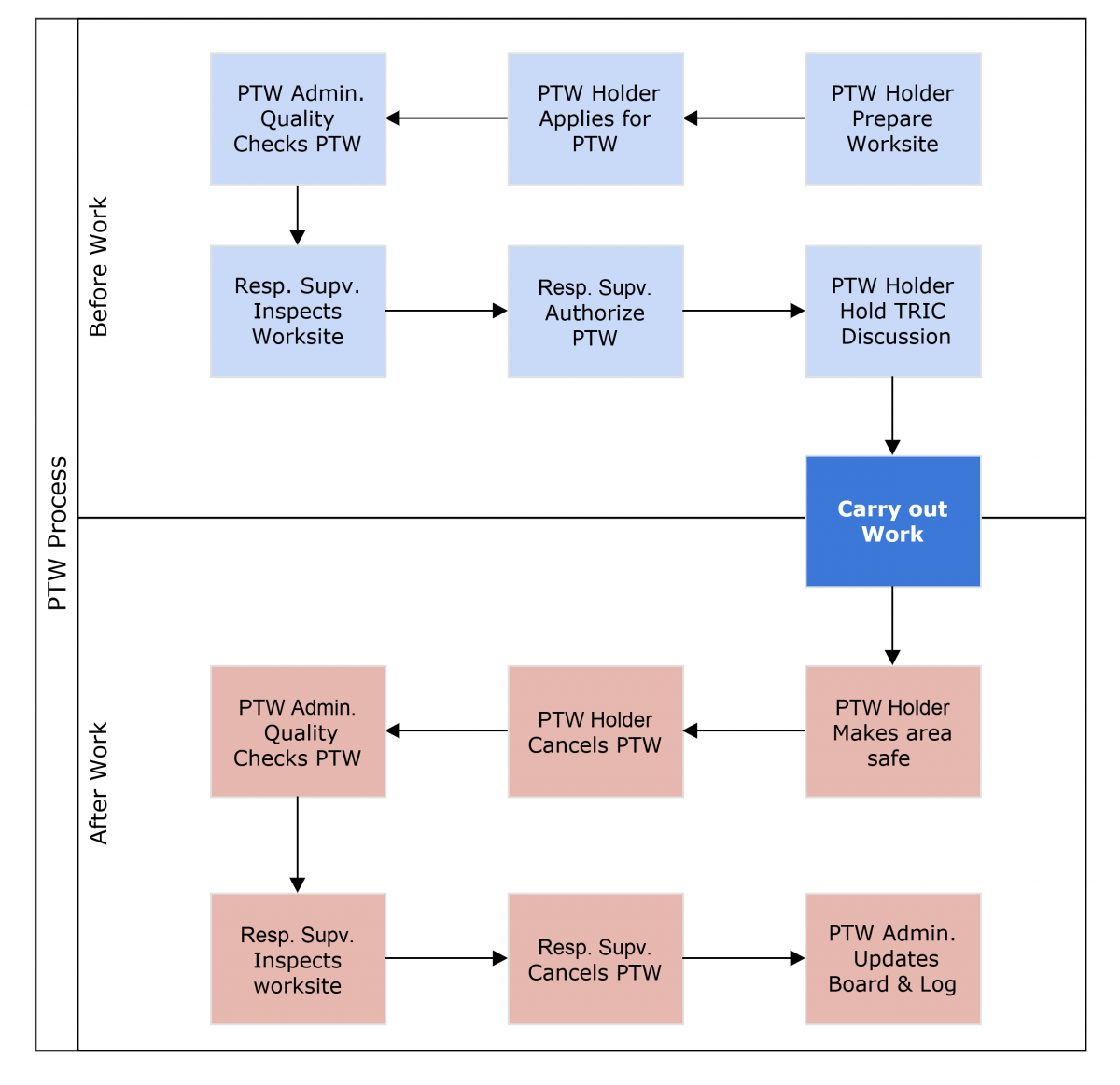
10. Documentation & Records
F-22 – PTW Register
Comments
Sign in to join the conversation