minor · other
Fatal High-Speed Train Collision in Spain
Jan 17, 2026
0
fatalities
0
injured
Sequence of events
Incident Overview
A high-speed train derailed on a straight section of track and collided head-on with an oncoming high-speed train on January 18, 2026, marking one of Europe's worst rail disasters in decades. The incident occurred at approximately 7:45 p.m. local time, involving around 400 passengers mostly returning to Madrid after the weekend. Investigators identified a broken joint on the track as a potential key factor, with the infrastructure recently renewed months prior.
Location and Facility Details
The crash site is near Adamuz, a town of about 5,000 residents in Córdoba province, southern Spain, roughly 360-370 km south of Madrid. It involved high-speed rail lines connecting Andalusia (including Málaga, Sevilla, Huelva) to Madrid, with one train operated by private company Iryo (Málaga to Madrid, ~300 passengers) and the other by state-owned Renfe (~100 passengers). The track, upgraded in May 2025, was straight, making the derailment highly unusual according to experts.
Incident Sequence and Response
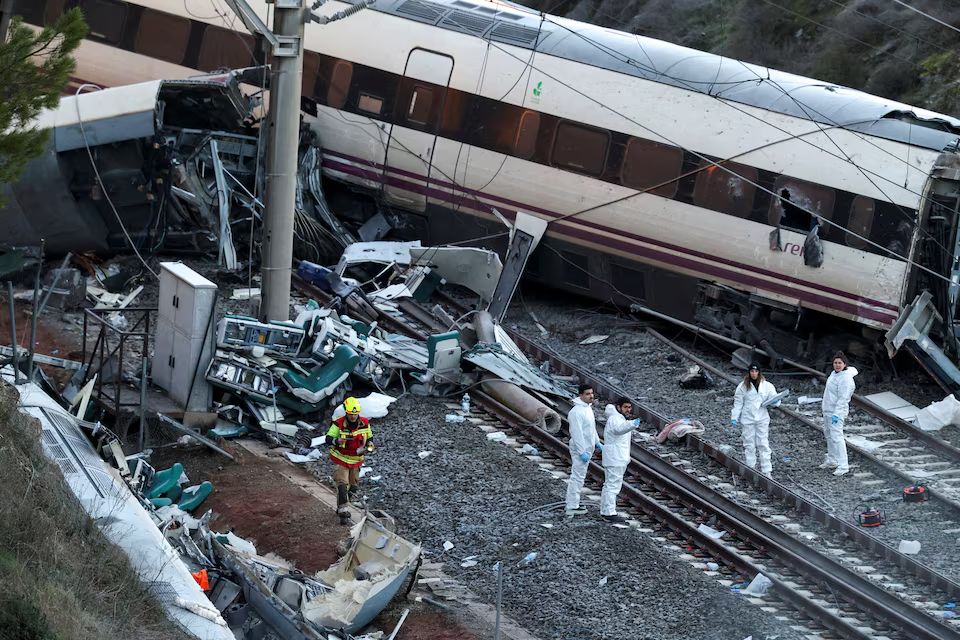
The Málaga-Madrid train derailed violently—described by survivors as feeling like an "earthquake"—with its last carriages overturning before slamming into the path of the oncoming Renfe train, whose front absorbed the impact and derailed. Emergency services, including fire crews, Civil Guard, and Red Cross, responded immediately, using floodlights amid twisted wreckage; a nearby sports center became a field hospital, and family assistance hubs were established. Over 200 trains were canceled the next day; Prime Minister Pedro Sánchez cleared his schedule, calling it a "night of deep pain."
Casualties and Evacuation
The death toll reached 39, including the Huelva-bound train operator, with 152 injured—many critically, including 24-30 in serious condition transported to hospitals. Evacuation involved passengers breaking windows with emergency hammers and rescuers extracting survivors from mangled carriages, often moving deceased to reach the living; DNA samples aid victim identification.
Additional Context
This is Spain's deadliest rail crash since the 2013 Santiago de Compostela derailment. Transport Minister Óscar Puente noted the trains were nearly new, baffling investigators who expect a full probe to take a month. Services between Madrid and Andalusia remain disrupted.
Safety Implications
The broken track joint highlights potential maintenance vulnerabilities even on recently upgraded high-speed infrastructure, urging rigorous joint inspections and monitoring systems. Emphasis on straight-track derailment prevention, rapid signaling tech, and emergency drills is critical for passenger rail safety worldwide.
Speak up before the next one
EntirelySafe gives workers a place to raise safety concerns, and gives safety leaders a way to see the patterns those concerns form — before they become an incident like this one.
Comments
Sign in to join the conversation