minor · other
High‑Pressure Gas Pipeline Fire Near Hattar Industrial Estate, Haripur
Apr 15, 2026
0
fatalities
0
injured
Sequence of events
Basic Incident Information
Date of incident: 16 April 2026
Time of incident: Around 6:30 p.m. (first reports to gas company)
Location: Sui Northern Gas Pipelines Ltd (SNGPL) supply line near a factory, close to 400 residential quarters in Hattar Industrial Estate, Haripur district, KP, Pakistan
Asset involved: 16‑inch‑diameter high‑pressure gas transmission/supply line feeding industrial estates up to Abbottabad
Incident type: High‑pressure gas pipeline fire with off‑site impact on nearby houses and residents
Incident Description
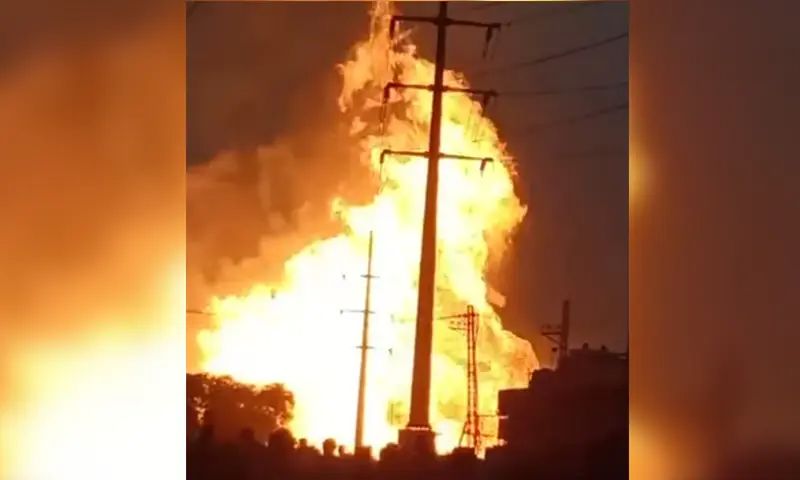
Officials reported that a Sui Northern Gas (SNGPL) supply line running through the Hattar Industrial Estate burst and caught fire, sending large flames into the air that were visible from kilometres away. The line, 16 inches in diameter, supplies gas to industrial estates as far as Abbottabad and passes close to around 400 residential quarters near the estate.
Residents informed SNGPL at about 6:30 p.m. of a “gas explosion and large fire,” after which field teams rushed to the scene and found the pipeline engulfed in flames. SNGPL staff cut off gas supply to the affected line, but due to the volume of gas already in the pipeline, the blaze took around two hours to extinguish, with Rescue 1122, firefighters, and other departments involved in the response. Deputy Commissioner (DC) Waseem Ahmed and District Police Officer (DPO) Shafiullah Khan supervised the firefighting and rescue operations, with the fire brought under control after roughly three hours.
Authorities indicated that three to four nearby houses within the affected radius suffered fire damage. Initial statements suggested that the deaths were mainly due to suffocation rather than direct burns.
Casualties and Damage
Fatalities: At least 8 people killed, including children.
Injuries: 11 people injured.
Medical response:
Three bodies taken to Haripur District Headquarters (DHQ) Hospital.
Five bodies taken to the Rural Health Centre (RHC) in Kot Najibullah union council.
Injured also treated at these facilities (exact breakdown not specified).
Property damage:
Fire affected three to four nearby houses; detailed structural damage assessment pending.
Early Technical and Causal Indicators
DPO Shafiullah Khan stated that circumstantial evidence suggests high gas pressure may have caused an explosion in the supply line.
SNGPL official Muhammad Amir said the pipeline’s proximity to industrial godowns likely storing chemical materials raises the possibility that leakage from those stores could have contributed to the fire, though he emphasised that the exact cause remains undetermined pending investigation.
At the time of reporting, the root cause (pipeline failure mode, ignition source, interaction with nearby chemical storage) had not yet been formally established.
Emergency Response Actions
SNGPL field teams isolated the affected line by cutting off gas supply.
Rescue 1122, fire brigade units, and personnel from other departments conducted firefighting and rescue operations.
DC Haripur and DPO Haripur oversaw operations, and rescue personnel searched the area to confirm that no additional victims were trapped.
Preliminary Learnings and Safety Focus
Even with the cause still under investigation, this incident highlights several critical gas‑pipeline and land‑use safety issues:
Pipeline integrity and pressure management: High‑pressure transmission and distribution lines must be designed, operated, and monitored to prevent over‑pressure and rupture, including robust pressure control, leak detection, and condition assessment of aging assets.
Proximity to residential and industrial occupancies: Routing of major gas lines near dense housing and industrial estates requires stringent risk assessments, appropriate separation distances or protective measures, and clear emergency planning with local authorities and residents.
Interface with adjacent chemical facilities: Where gas pipelines run close to industrial godowns storing flammable or reactive chemicals, joint hazard mapping and emergency planning between the gas utility and estate management are essential to manage escalation risk.
Community warning and evacuation: As deaths were reported mainly from suffocation, rapid public warning, evacuation or shelter‑in‑place instructions, and community education on how to respond to gas fires and fumes can significantly reduce casualties.
Speak up before the next one
EntirelySafe gives workers a place to raise safety concerns, and gives safety leaders a way to see the patterns those concerns form — before they become an incident like this one.
Comments
Sign in to join the conversation